Enhancement of sustainability
When making property more sustainable, people often immediately think of adding solar panels or upgrading insulation. But when you look at the definition of sustainable in the Dikke Van Dale (the authoritative Dutch dictionary), it states:
- Long-lasting
- little subject to wear or decay
- environmentally friendly
The Dikke Van Dale thus uses a broader definition of sustainability than is often assumed. While solar panels and insulation focus mainly on reducing environmental impact by lowering (fossil) energy consumption, it is also valuable to look at the lifespan and quality of real estate. Service life can be looked at in different ways. One way is to construct a building that can be used for a long time. Take the canal houses in Amsterdam for example: these buildings have been around for many years and have had different functions over time, such as housing, offices, shops or hotels. Thanks to this flexibility in terms of functions, the buildings have a certain quality, making them last a long time. In order to make a building sustainable, we should therefore not only look at the environmental aspect, but also at its flexibility in terms of functions and layout, among other things. In this way, a building can remain in use for a long time. Making a building more sustainable requires more than just a one-sided approach based on environmental impact. Flexibility in terms of functions and lay-out should therefore also be considered.
vb&t Preservatives
From our experience at vb&t Projectmanagement, where we develop and realise projects for our clients, sustainability has always been one of the components of the total project. Alongside aesthetics, construction, installations, and execution techniques, sustainability is one of the project's pillars. This has led to us completing a large number of (sustainability) projects. Because it has always been a part of the whole, seeking balance in quality, this leads to an integrated approach. We want to continue and expand this experience and attitude within vb&t Verduurzamers. Where projects are now initiated from a sustainability perspective, we still want to maintain an integrated vision of a building. This is because we are convinced that an integrated approach leads to the most sustainable building (in terms of environment, flexibility, and lifespan).
Plan of action
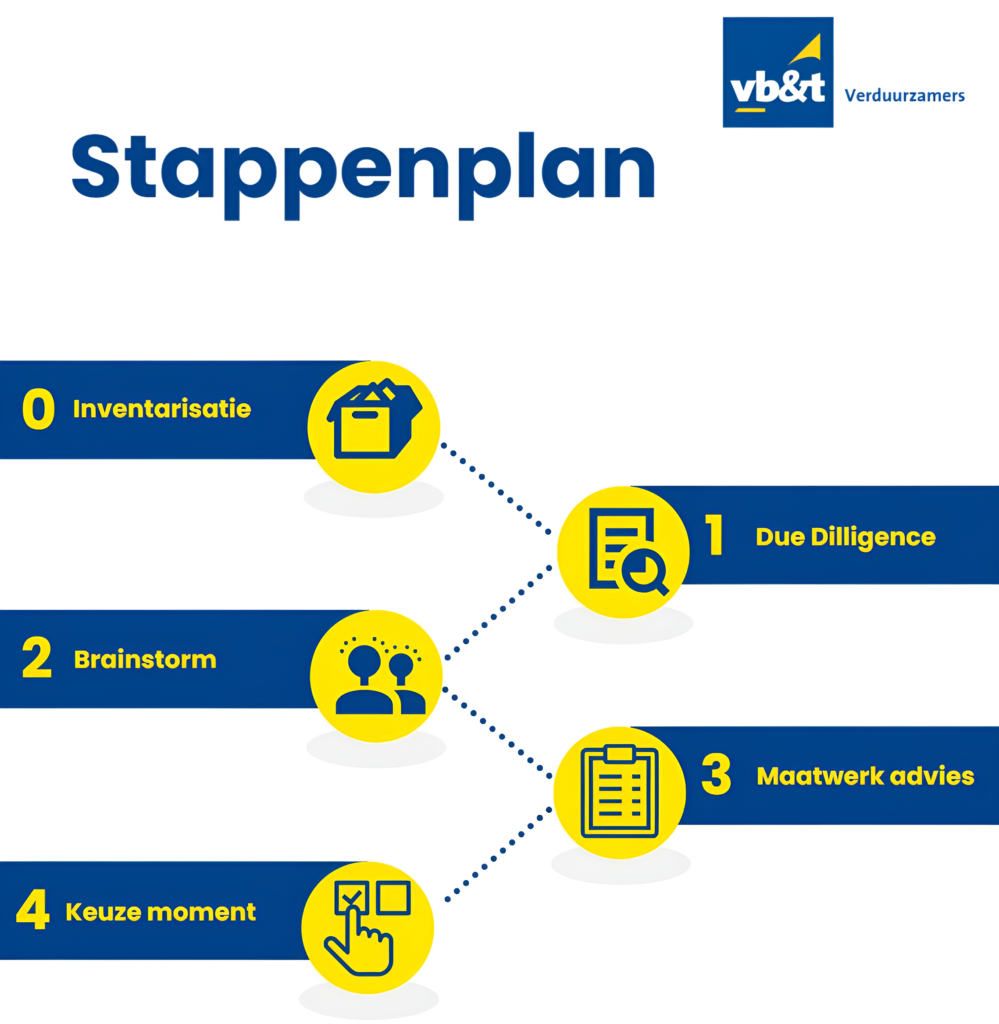
To arrive at comprehensive, tailor-made advice, we employ a structured approach consisting of five phases:
0. Inventory / baseline measurement
We begin by gathering relevant information, such as the Multi-Year Maintenance Plan (MJOP), the energy label, building plans, and existing reports about the building. If data is missing, it can be compiled additionally. Subsequently, the property will be inspected (site survey) and a meeting will take place with the manager and/or client to record requirements, wishes, and specific details.
1. Due Diligence
Once all the data has been collected, we will begin the analysis with various consultants. The architect will assess material usage, building function, facades, roofs, and interior design. The engineering consultant will analyse the technical installations and building physics. An outdoor space consultant will focus on green and environmental aspects. Generally, aspects such as monumental status, asbestos, and zoning plans will be investigated. This will also include looking at the added value for future use, such as Total Cost of Housing (TCH) and market attractiveness (value/rentability).
Brainstorming session
After the individual analyses, the consultants come together to discuss the opportunities. A joint brainstorming session will determine which opportunities are most feasible and valuable.
3. Implementation of bespoke advice
The results of the brainstorming session will be elaborated in an opportunity map. This will contain an overview of all sustainability measures, an explanation per measure, and a cost overview including subsidies. Sometimes, additional measures can be advised to obtain higher subsidies, which can lead to a lower net investment.
4. Decision-making and realisation
The client ultimately decides which measures are implemented. We offer guidance in the choices and implementation of these measures. Our team ensures that the sustainability improvements are realised according to the agreed strategy, so that both environmental and business objectives are achieved. Together, we ensure a future-proof building that meets all sustainability requirements.